

Thyroid Problems: Symptoms, Diagnosis, and Treatment in McAllen

Your thyroid is a small, butterfly-shaped gland located at the base of your neck, just below your Adam's apple. Despite its small size, this gland has an enormous impact on your health. The thyroid produces hormones that regulate your metabolism, energy levels, heart rate, body temperature, and even your mood. When your thyroid is not functioning properly, the effects can be felt throughout your entire body.
Thyroid disorders are remarkably common, affecting an estimated 20 million Americans, yet many people with thyroid problems remain undiagnosed. The symptoms can be vague and easily attributed to stress, aging, or other conditions. If you have been experiencing unexplained fatigue, weight changes, mood fluctuations, or other persistent symptoms, finding a thyroid doctor near me in McAllen could be the key to finally getting answers.
In this comprehensive guide, we will explore how the thyroid works, the most common thyroid disorders, how thyroid problems are diagnosed, treatment options, and what to expect when working with your doctor to manage a thyroid condition.
Understanding the Thyroid: A Small Gland with Big Responsibilities
The thyroid gland is part of your endocrine system, a network of glands that produce hormones to regulate bodily functions. The thyroid produces two main hormones:
- Thyroxine (T4): The primary hormone produced by the thyroid; most of it is converted to T3 in the body
- Triiodothyronine (T3): The more active form of thyroid hormone
These hormones influence virtually every cell, tissue, and organ in your body. They control:
| Function | How Thyroid Hormones Affect It |
|---|---|
| Metabolism | Regulate how your body converts food into energy |
| Heart rate | Influence how fast or slow your heart beats |
| Body temperature | Help regulate your internal thermostat |
| Weight | Affect how efficiently you burn calories |
| Energy levels | Determine whether you feel energetic or fatigued |
| Mood | Influence mental well-being and emotional stability |
| Muscle strength | Affect muscle function and recovery |
| Cholesterol | Help regulate blood lipid levels |
| Menstrual cycles | Impact regularity and flow in women |
| Bone health | Affect bone turnover and density |
How Thyroid Hormone Production Is Regulated
The thyroid operates under the control of the pituitary gland (located at the base of the brain) through a feedback loop:
- The pituitary gland releases thyroid-stimulating hormone (TSH)
- TSH signals the thyroid to produce T4 and T3
- When thyroid hormone levels rise, the pituitary reduces TSH production
- When thyroid hormone levels fall, the pituitary increases TSH production
This feedback system is why measuring TSH is such a valuable tool for assessing thyroid function. A high TSH level typically indicates an underactive thyroid (hypothyroidism), while a low TSH level suggests an overactive thyroid (hyperthyroidism).
Thyroid Disease Prevalence: How Common Is It?
Thyroid disorders are far more common than many people realize. According to research published in medical journals:
Thyroid Disease Statistics
| Statistic | Data |
|---|---|
| Americans with thyroid disease | 20+ million |
| Percentage of population affected | ~5% (age-standardized, 2015-2018) |
| People unaware of their thyroid condition | Up to 60% |
| Women vs. men affected by hypothyroidism | 5-9 times more likely in women |
| Adults 60+ with thyroid disease | 15.4% |
| Growth in hypothyroidism prevalence (2012-2019) | 9.6% to 11.7% |
Who Is Most at Risk?
Certain groups have higher rates of thyroid disorders:
- Women: Much more likely to develop thyroid problems than men
- Adults over 60: Prevalence increases significantly with age
- People with family history: Thyroid disorders often run in families
- People with other autoimmune conditions: Diabetes type 1, rheumatoid arthritis, lupus
- Post-pregnancy women: Risk increases in the months after giving birth
- History of radiation exposure: Including radiation therapy to the neck area
Common Thyroid Conditions
There are several types of thyroid disorders, each with distinct characteristics:
Hypothyroidism (Underactive Thyroid)
Hypothyroidism occurs when the thyroid does not produce enough hormones. This slows down metabolic processes throughout the body. It is the most common thyroid disorder.
Causes:
- Hashimoto's disease: An autoimmune condition where the immune system attacks the thyroid (most common cause)
- Surgical removal of thyroid: Treatment for thyroid cancer or other conditions
- Radiation therapy: Especially to the head and neck
- Certain medications: Lithium, amiodarone, and others
- Iodine deficiency: Rare in the U.S. due to iodized salt
- Pituitary disorders: Failure of the pituitary to produce adequate TSH
Symptoms of Hypothyroidism:
| Physical Symptoms | Mental/Emotional Symptoms |
|---|---|
| Fatigue and weakness | Depression |
| Weight gain | Memory problems |
| Cold intolerance | Difficulty concentrating |
| Dry skin and hair | Slowed thinking |
| Hair loss | Irritability |
| Constipation | Low motivation |
| Muscle aches and stiffness | |
| Puffy face | |
| Hoarse voice | |
| Slow heart rate | |
| Elevated cholesterol | |
| Irregular or heavy menstrual periods |
Hyperthyroidism (Overactive Thyroid)
Hyperthyroidism occurs when the thyroid produces too much hormone, speeding up metabolic processes.
Causes:
- Graves' disease: An autoimmune condition where antibodies stimulate excessive thyroid hormone production (most common cause)
- Toxic nodular goiter: Nodules that produce excess thyroid hormone
- Thyroiditis: Inflammation causing stored hormone to leak into the bloodstream
- Excessive iodine intake: Including certain medications and supplements
- Thyroid medication overdose: Taking too much levothyroxine
Symptoms of Hyperthyroidism:
| Physical Symptoms | Mental/Emotional Symptoms |
|---|---|
| Unexplained weight loss | Anxiety and nervousness |
| Rapid or irregular heartbeat | Irritability |
| Trembling hands | Difficulty sleeping |
| Increased sweating | Restlessness |
| Heat intolerance | |
| More frequent bowel movements | |
| Muscle weakness | |
| Thin, fragile skin | |
| Fine, brittle hair | |
| Enlarged thyroid (goiter) | |
| Bulging eyes (in Graves' disease) | |
| Light or missed menstrual periods |
Thyroid Nodules
Thyroid nodules are lumps that form within the thyroid gland. They are very common, detected in up to 50% of adults on ultrasound, and most are benign (non-cancerous).
Key Points:
- Most nodules cause no symptoms
- Larger nodules may be visible or felt in the neck
- Some nodules produce excess thyroid hormone ("hot" nodules)
- A small percentage (5-15%) are cancerous
- Evaluation typically includes ultrasound and possibly fine-needle biopsy
Hashimoto's Disease (Chronic Lymphocytic Thyroiditis)
Hashimoto's disease is an autoimmune condition in which the immune system attacks the thyroid, gradually destroying its ability to produce hormones. It is the most common cause of hypothyroidism in the United States.
Characteristics:
- Often runs in families
- More common in women
- Develops gradually over years
- May initially cause periods of hyperthyroidism before progressing to hypothyroidism
- Diagnosed by antibody testing (TPO antibodies, thyroglobulin antibodies)
Graves' Disease
Graves' disease is an autoimmune condition that causes hyperthyroidism. Antibodies stimulate the thyroid to produce excessive amounts of hormone.
Characteristics:
- Most common cause of hyperthyroidism
- Can cause eye problems (Graves' ophthalmopathy) with bulging eyes, irritation, and double vision
- May cause thickened, reddish skin on the shins (pretibial myxedema)
- Treatment options include medications, radioactive iodine, or surgery
Diagnosing Thyroid Problems: What to Expect
If you are searching for a thyroid doctor near me because you suspect a thyroid problem, here is what the diagnostic process typically involves:
Step 1: Medical History and Physical Examination
Your doctor will ask about:
- Your symptoms and when they started
- Family history of thyroid disease
- Other medical conditions
- Medications and supplements you take
- Previous thyroid tests or treatments
During the physical exam, your doctor will:
- Feel your thyroid gland for enlargement or nodules
- Check your heart rate and rhythm
- Examine your skin, hair, and eyes
- Assess your reflexes
- Look for signs of thyroid dysfunction
Step 2: Thyroid Blood Tests
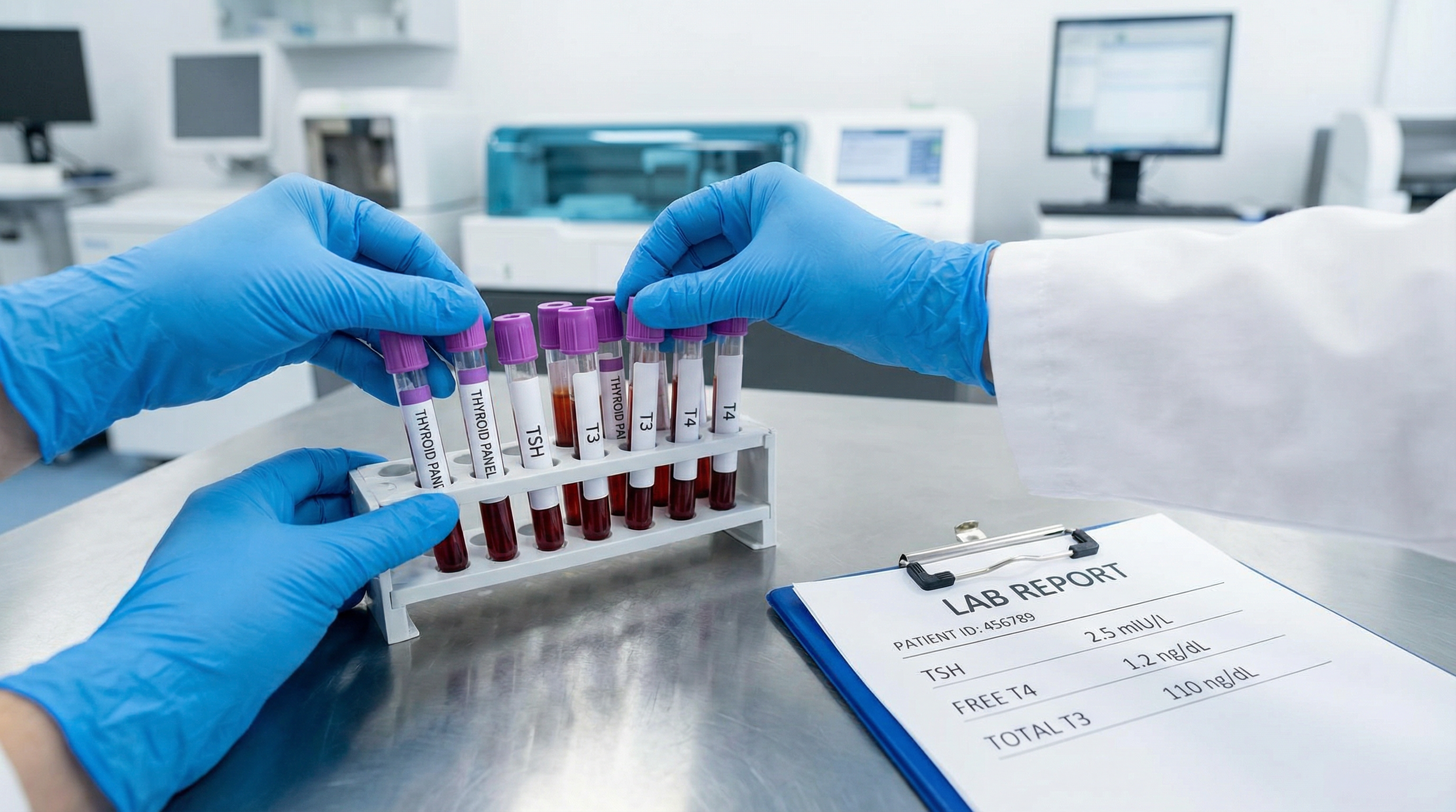
Blood tests are the cornerstone of thyroid diagnosis.
TSH (Thyroid-Stimulating Hormone):
TSH is typically the first and most important test ordered. According to the American Thyroid Association:
| TSH Level | Interpretation |
|---|---|
| 0.4, 4.0 mIU/L | Normal range |
| Below 0.4 mIU/L | Suggests hyperthyroidism |
| Above 4.0-4.5 mIU/L | Suggests hypothyroidism |
| 4.5, 10 mIU/L | Subclinical hypothyroidism (may or may not require treatment) |
| Above 10 mIU/L | Overt hypothyroidism (treatment typically recommended) |
Note: TSH levels can vary throughout the day (highest in early morning) and with age (tend to increase slightly in older adults).
Additional Thyroid Tests:
| Test | What It Measures | When It Is Used |
|---|---|---|
| Free T4 (FT4) | Active thyroxine hormone | When TSH is abnormal |
| Free T3 (FT3) | Active triiodothyronine | When hyperthyroidism is suspected |
| TPO Antibodies | Thyroid peroxidase antibodies | To diagnose Hashimoto's disease |
| Thyroglobulin Antibodies | Autoantibodies to thyroglobulin | To diagnose autoimmune thyroid disease |
| TSI (Thyroid-Stimulating Immunoglobulin) | Antibodies causing Graves' disease | To diagnose Graves' disease |
Step 3: Imaging Studies (When Needed)
Thyroid Ultrasound:
- Non-invasive, painless imaging
- Evaluates size and structure of the thyroid
- Detects and characterizes nodules
- Helps determine if further evaluation is needed
Thyroid Scan (Radioactive Iodine Uptake):
- Uses a small amount of radioactive iodine
- Shows how the thyroid is functioning
- Identifies "hot" nodules (producing excess hormone) vs. "cold" nodules (not functioning)
- Used primarily when hyperthyroidism is suspected
Step 4: Fine-Needle Aspiration Biopsy (When Needed)
If a thyroid nodule has suspicious features on ultrasound, a fine-needle aspiration (FNA) biopsy may be recommended:
- A thin needle is inserted into the nodule
- Cells are collected and examined under a microscope
- Results help determine if the nodule is benign, suspicious, or cancerous
- Most nodules are found to be benign
Treatment Options for Thyroid Conditions
The good news is that most thyroid disorders are very treatable. Your treatment will depend on the specific condition, its severity, your age, and overall health.
Treatment for Hypothyroidism
Levothyroxine (Synthetic T4):
Levothyroxine is the standard treatment for hypothyroidism. This medication replaces the hormone your thyroid is not producing. Key points:
| Aspect | Details |
|---|---|
| How it works | Replaces missing thyroid hormone |
| How it is taken | Once daily, on an empty stomach |
| When to take it | 30-60 minutes before breakfast, or at bedtime (at least 3 hours after eating) |
| Onset of effect | Improvement often noticed within 2-3 weeks |
| Monitoring | TSH checked 6-8 weeks after starting or adjusting dose |
| Goal | TSH within normal range (0.4-4.0 mIU/L); some patients feel best at 1-2 mIU/L |
Important Tips for Taking Levothyroxine:
- Take it at the same time every day
- Separate from calcium supplements, iron, and antacids by 4 hours
- Separate from food and coffee by 30-60 minutes
- Do not stop taking it without talking to your doctor
- Some brands are not interchangeable, stick with the same brand if possible
Monitoring and Adjustments:
Once your dose is stable, TSH is typically checked every 6-12 months. Dose adjustments may be needed if:
- Your symptoms change
- You gain or lose significant weight
- You become pregnant
- You start or stop other medications
- You reach an older age
Treatment for Hyperthyroidism
Several treatment options are available for hyperthyroidism:
Antithyroid Medications:
- Methimazole (preferred) or propylthiouracil (PTU)
- Block the production of thyroid hormone
- May be used long-term or as preparation for other treatments
- Require monitoring for side effects (rare but serious liver and bone marrow effects)
Radioactive Iodine Therapy:
- Taken orally as a capsule or liquid
- The thyroid absorbs the iodine, which destroys overactive thyroid cells
- Often results in permanent hypothyroidism requiring levothyroxine replacement
- Most common definitive treatment in the U.S.
Surgery (Thyroidectomy):
- Partial or total removal of the thyroid
- Used for large goiters, suspicious nodules, or when other treatments are not appropriate
- Results in permanent hypothyroidism requiring lifelong hormone replacement
Beta-Blockers:
- Do not treat the underlying thyroid problem
- Provide rapid relief of symptoms like rapid heart rate, tremors, and anxiety
- Often used while waiting for other treatments to take effect
Treatment for Thyroid Nodules
Treatment depends on the nature of the nodule:
| Nodule Type | Treatment Approach |
|---|---|
| Benign, small, no symptoms | Observation with periodic ultrasound |
| Benign, large or causing symptoms | Consider surgery or other procedures |
| Suspicious or cancerous | Surgery, possible radioactive iodine, thyroid hormone suppression |
| Functioning ("hot") nodule | Radioactive iodine or surgery |
Living with a Thyroid Condition: Practical Tips
Managing a thyroid condition is typically straightforward once you have the right diagnosis and treatment. Here are some practical tips:
For Hypothyroidism
- Take your medication consistently: Same time every day, as directed
- Be patient: It may take several weeks to feel better and several months to find the optimal dose
- Keep follow-up appointments: Regular monitoring ensures your dose remains appropriate
- Report new symptoms: Let your doctor know if symptoms change
- Manage related conditions: Address weight, cholesterol, and other health factors
- Be aware of interactions: Many medications and supplements can affect levothyroxine absorption
For Hyperthyroidism
- Follow your treatment plan: Take medications as prescribed
- Watch for side effects: Report any concerning symptoms to your doctor immediately
- Protect your eyes: If you have Graves' disease, protect your eyes from wind and bright light; use artificial tears if needed
- Avoid iodine-rich foods during treatment: If using radioactive iodine
- Plan for hypothyroidism: After radioactive iodine or surgery, you will likely need levothyroxine
Diet and Nutrition
While no specific diet cures thyroid problems, some considerations include:
- Iodine: Most Americans get adequate iodine from salt and food; excess iodine can worsen some thyroid conditions
- Selenium: Found in Brazil nuts, fish, and eggs; may support thyroid function
- Soy and fiber: May interfere with levothyroxine absorption if consumed at the same time
- Cruciferous vegetables: Unlikely to cause problems unless consumed in very large amounts
- Gluten: Some people with Hashimoto's also have celiac disease or gluten sensitivity
Frequently Asked Questions About Thyroid Problems
Q: Can thyroid problems be cured?
A: It depends on the condition. Hyperthyroidism can often be cured with radioactive iodine or surgery, though this usually results in hypothyroidism requiring lifelong medication. Hypothyroidism is typically a lifelong condition that is managed with medication rather than cured. The good news is that with proper treatment, most people with thyroid disorders live normal, healthy lives.
Q: How long does it take to feel better after starting thyroid medication?
A: Many people notice improvement in energy and other symptoms within 2-3 weeks of starting levothyroxine. However, it can take 6-8 weeks for hormone levels to stabilize, and some people need several dose adjustments before feeling their best. Be patient and communicate with your doctor about how you are feeling.
Q: Can I stop taking thyroid medication if I feel better?
A: No. If you have hypothyroidism, you will typically need to take levothyroxine for life. Stopping the medication will cause your symptoms to return and can lead to serious health problems. Even if you feel great, continue taking your medication as prescribed and keep your follow-up appointments.
Q: Are thyroid problems hereditary?
A: Thyroid disorders, especially autoimmune conditions like Hashimoto's and Graves' disease, tend to run in families. If close family members have thyroid problems, you may be at higher risk and should be vigilant about symptoms and consider periodic screening.
Q: Can thyroid problems cause weight gain?
A: Yes, hypothyroidism (underactive thyroid) can cause weight gain because it slows your metabolism. However, the weight gain attributable to thyroid dysfunction is usually modest (5-10 pounds). If you have gained significantly more weight, other factors are likely involved. Treating hypothyroidism can help, but weight loss may still require attention to diet and exercise.
Q: Do I need to see an endocrinologist, or can my primary care doctor treat my thyroid?
A: Most thyroid conditions can be effectively managed by a primary care physician or internist experienced in thyroid care. You may need to see an endocrinologist if you have a complex thyroid condition, difficulty achieving stable hormone levels, thyroid cancer, pregnancy with thyroid disease, or Graves' eye disease.
Q: How often do I need thyroid blood tests?
A: After starting or changing thyroid medication, TSH is typically checked at 6-8 weeks. Once your levels are stable, testing every 6-12 months is usually sufficient. More frequent monitoring may be needed during pregnancy, with major weight changes, or if symptoms change.
Q: Can stress cause thyroid problems?
A: While stress does not directly cause thyroid disease, it may trigger or worsen autoimmune thyroid conditions in susceptible individuals. Stress can also cause symptoms that mimic thyroid problems. Managing stress is always beneficial for overall health.
Q: Can thyroid problems affect fertility or pregnancy?
A: Yes. Both hypothyroidism and hyperthyroidism can affect fertility and increase the risk of complications during pregnancy. If you have a thyroid condition and are planning pregnancy, work closely with your doctor to optimize your thyroid levels before and during pregnancy. TSH should be closely monitored, and medication doses often need adjustment.
Q: What is the connection between thyroid and heart problems?
A: Thyroid hormones directly affect the heart. Hypothyroidism can raise cholesterol and increase heart disease risk. Hyperthyroidism can cause rapid heart rate, atrial fibrillation, and heart failure. Proper treatment of thyroid disorders protects heart health.
When to See a Thyroid Doctor
Consider seeking evaluation for thyroid problems if you experience:
- Persistent unexplained fatigue
- Unexplained weight changes (gain or loss)
- Feeling unusually cold or hot
- Changes in heart rate (too fast or too slow)
- Hair loss or changes in hair texture
- Dry skin
- Mood changes (depression, anxiety, irritability)
- Difficulty concentrating or memory problems
- Changes in menstrual patterns
- A lump or swelling in your neck
- Family history of thyroid disease
Why Choose Giraldo Internal Medicine for Thyroid Care?
At Giraldo Internal Medicine, we have extensive experience diagnosing and treating thyroid conditions in McAllen, TX. If you are searching for a thyroid doctor near me, our team is here to provide the comprehensive care you need.
Our Approach to Thyroid Care
- Thorough evaluation: We take time to understand your symptoms and medical history
- Appropriate testing: We order the right tests to accurately diagnose your condition
- Personalized treatment: We work with you to find the best treatment approach for your situation
- Careful monitoring: We track your progress and adjust treatment as needed
- Patient education: We explain your condition and answer your questions
- Bilingual care: Our team communicates fluently in English and Spanish
- Coordination with specialists: We refer to endocrinologists when specialized care is needed
Take the First Step: Schedule Your Thyroid Evaluation
If you have been experiencing symptoms that might be related to a thyroid problem, do not wait to get answers. A simple blood test can reveal whether your thyroid is functioning properly, and treatment can restore your energy, mood, and overall well-being.
Contact Giraldo Internal Medicine today:
- Phone: (956) 000-0000
- Address: 1200 Savannah Ave STE 14, McAllen, TX 78503
- Website: giraldointernalmedicine.com
We accept Medicare, Medicare Advantage, and most major insurance plans. Take control of your health and discover whether a thyroid condition might be the cause of your symptoms.
References and Resources
- American Thyroid Association: Thyroid Disease Information
- Endocrine Society: Thyroid Guidelines
- AAFP: Hypothyroidism Diagnosis and Treatment Guidelines
- National Institute of Diabetes and Digestive and Kidney Diseases (NIDDK): Thyroid Information
- Journal of the Endocrine Society: Thyroid Disease Prevalence Studies
